
.jpeg) |
| Tarique rahman Acting chairman, bnp. |
Tarique Rahman on Why the BNP Is Boycotting the Bangladesh Elections
“As long as Hasina retains power, every election in Bangladesh will involve extensive irregularities, making the much-anticipated level-playing field a distant dream.”
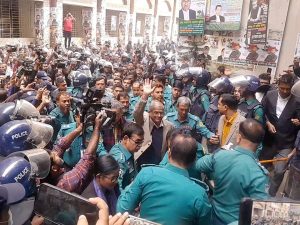
Supporters of the Bangladesh Nationalist Party (BNP) gather in front of a court in Dhaka where senior party leaders Secretary General Mirza Fakhrul Alamgir and National Standing Committee member Amir Khasru Mahmud Chowdhury were being produced before the court, Dec. 18, 2023.
Bangladesh is scheduled to vote in general elections on January 7, 2024. However, the Bangladesh Nationalist Party, the country’s largest opposition party, is boycotting the election. It has alleged that an election held under the ruling Awami League will not be free or fair. It has been holding protest rallies across the country over the past yeIn an interview with The Diplomat’s Snigdhendu Bhattacharya, the BNP’s acting Chairman Tarique Rahman explains why his party is boycotting the election. “The predetermined upcoming election,” he said, “is non-participatory not just for the political parties, but the voters as well.” The son of former Bangladesh President Ziaur Rahman and former Prime Minister Khaleda Zia, Rahman, who spent 18 months in jail during 2006-07, has been living in self-imposed exile in London since 2008.In this interview, Rahman discusses the BNP’s political strategy, the prospects for a free and fair election, and geopolitical considerations. Rahman argues that India’s concerns over the BNP’s ties with the Jamaat-e-Islami are misplaced, as the AL has aligned with the Islamist party several times in the past.
Why is the BNP determined to go ahead with the boycott of the 2024 elections?
It’s not the BNP alone, another 62 pro-democracy political parties have decided to boycott the so-called election on January 7. This decision arises from our commitment to representing the aspirations of the Bangladeshi people, ensuring their participation in a meaningful election, where they can freely cast their votes and those votes will be genuinely counted.
The tainted history of farcical elections under Prime Minister Sheikh Hasina, marked by various methods of rigging and irregularities, is well-documented globally. In 2014, the Awami League (AL) claimed 154 out of 300 seats uncontested, without any opposition candidate. In 2018, ballot boxes were stuffed the night before election day, making a mockery of democracy.
The AL is orchestrating another fraudulent election in 2024, with predetermined results negotiated with every participating party during the election build-up. The parties participating in the election are primarily historical allies of the AL, lacking public credibility. Among them, the Jatiya Party (JP) is the only party with some public base. However, the grassroots leaders of JP, in a meeting, expressed a vehement desire to boycott the election and terminate the alliance with AL, following which the state apparatus met the JP leadership and forced them to participate.
Sheikh Hasina has instructed AL candidates to field dummy candidates, not to win, but to boost the number of participants. Exploiting state resources, she unsuccessfully attempted to divide the BNP, and patronized the formation of so-called King’s parties (parties formed by opposition camp deserters with state backing), to create a false sense of inclusiveness with thousands of candidates. While there have been hiccups in AL’s seat distribution, such as the Zaker Party withdrawing over 200 candidates on the last day, many candidates from other small parties also wanted to withdraw but were reportedly barred by intelligence agencies.
If we see the inconsequential by-elections under Sheikh Hasina, AL activists engaged in extensive vote-rigging, continuing their longstanding pattern of manipulating elections with the aid of state resources. Each election witnessed the expulsion of agents representing opposition candidates from polling stations, blatant cases of flawed voter lists, fake voting, and the stuffing of ballot boxes. Last month, we encountered a new height of election fraud, when an AL polling agent managed to stamp 43 ballots in 57 seconds. It is evident that as long as Hasina retains power, every election in Bangladesh will involve extensive irregularities, making the much-anticipated level-playing field a distant dream.
As the election draws closer, the fascist regime is intensifying its nationwide crackdown on opposition leaders and activists, to purposefully create an atmosphere that is not conducive for inclusive elections. Prisons are overcrowded, yet arbitrary detention in fabricated cases persists, along with gross human rights violations such as enforced disappearances, extrajudicial killings, and brutal tortures. It is evident that only an inclusive, credible, and transparent election process, conducted under a non-political, neutral, election-time government, can reinstate voting rights and derive a public mandate in Bangladesh.
Won’t the BNP’s street agitations lose momentum in a few weeks, especially when the new government is in place?
Since Sheikh Hasina came to power in 2009, 2,687 persons have become victims of extrajudicial killings by law enforcement agencies, along with at least 675 documented instances of enforced disappearances. Over 138,500 politically motivated cases have been launched, against 5 million members of BNP and other democratic parties. Since our grand rally on October 28, over 22,000 leaders and activists have been arrested. The total number of inmates in jail is almost 2.5 times the capacity, even as the spree of arrests continues.
The BNP has endured unprecedented repression and injustice at the hands of the regime. This is a testament to our commitment to upholding democratic principles for the nation. As the main opposition party, we see it as our duty to restore the power that was unjustly taken away from the citizens but rightfully belongs to them. Regardless of whether the so-called election transpires or if Sheikh Hasina clings to power, the people of Bangladesh will remain united, with their deep-rooted public support for the BNP. While there could be strategic adjustments, looking at the bigger picture, the momentum of our movement can only go onward and upward from here.
The BNP’s latest rally on December 16, attended by hundreds of thousands of pro-democracy people, serves as a testament to our resilience against state-sponsored violence and the capacity to mobilize the masses. Over the past few years, we have organized massive rallies across Bangladesh, drawing millions of attendees, and marking an unprecedented chapter of participation in the nation’s history.
There is intense pressure on the AL government and the Election Commission to hold a free and fair election. Is the BNP convinced that this pressure won’t work?
Your question in itself is self-explanatory, vindicating an unfavorable condition for free and fair election, and reinforcing the moral and legitimate ground of our ongoing movement. The latest assertion of Agriculture Minister Abdur Razzaque that the BNP did not accept the proposal of joining the election in exchange for all its detained leaders getting released overnight, whom he claims have been kept in jail as part of a plan, exposes how the election build-up is marred by political arrests and judicial harassments by AL.
Sheikh Hasina has politicized the state apparatus – including judiciary, police, civil and military bureaucracy – by filling them with loyalists and making clear the consequences for not obeying illegal orders. She has wielded these institutions both to stifle dissent and carry out personal vengeance against political opponents.
The Election Commission’s indifference to the massive clampdown, and its approval of fake entities posing as parties and election observers, further proves the compromised integrity of the electoral process. The recent decision by the Commission directing the Ministry of Home Affairs to prohibit all political events except for election campaigns is troubling. The move to officially curb freedom of assembly and expression is not only unethical, illegal, and unconstitutional, but also indicative of Hasina’s overt control and manipulation of the Election Commission.
The BNP’s boycott of the 2014 election did not affect the Hasina government much in terms of international relations. On what basis is the BNP expecting its boycott of the upcoming election to weaken the Hasina government internationally?
Bangladesh is effectively ruled by a corrupt one-party government, propped up by oligarchs at home and authoritarian regimes abroad. Sheikh Hasina not only encourages threatening rhetoric against democratic nations, but also formulates controversial bilateral relations, leading to a gradual alienation from the democratic world. She disregards global calls for democratic principles and shows disrespect for the rules-based international order.
As democracy and human rights form the connecting bridge among democratic nations, the aspiration of the international community and Bangladeshi citizens converge in the shared goal of achieving a free, fair, participatory, and peaceful election. We are grateful to international stakeholders and development partners of Bangladesh, including the U.S., U.N., EU, U.K., Australia, Canada, Japan, and various human rights organizations for their moral support inspiring the pro-democracy movement. The people of Bangladesh greatly appreciate recent diplomatic measures, such as the U.S. sanctions on the Rapid Action Battalion and its visa restrictions, and the common call for credible elections, all of which play a crucial role in advancing democracy.


.jpg)


.jpeg&description=In the interview of "BNP acting chairman Tareque Rahman" on the international channel The Diplomat, the topic of Bangladesh election came up. Why did BNP withdraw from the election)
0 মন্তব্যসমূহ